The Canadian dollar continues to improve, as USD/CAD dropped close to 100 points for the second straight week. The pair closed at 1.0662. This week has just two releases on the calendar – GDP and Trade Balance. Here is an outlook on the major events and an updated technical analysis for USD/CAD.
US GDP for Q1 shocked the markets with a decline of 2.9%, and the Canadian dollar took advantage. Unemployment Claims and Consumer Sentiment were close to the estimates. In Canada, manufacturing inflation posted declines, pointing to weakness in the manufacturing sector.
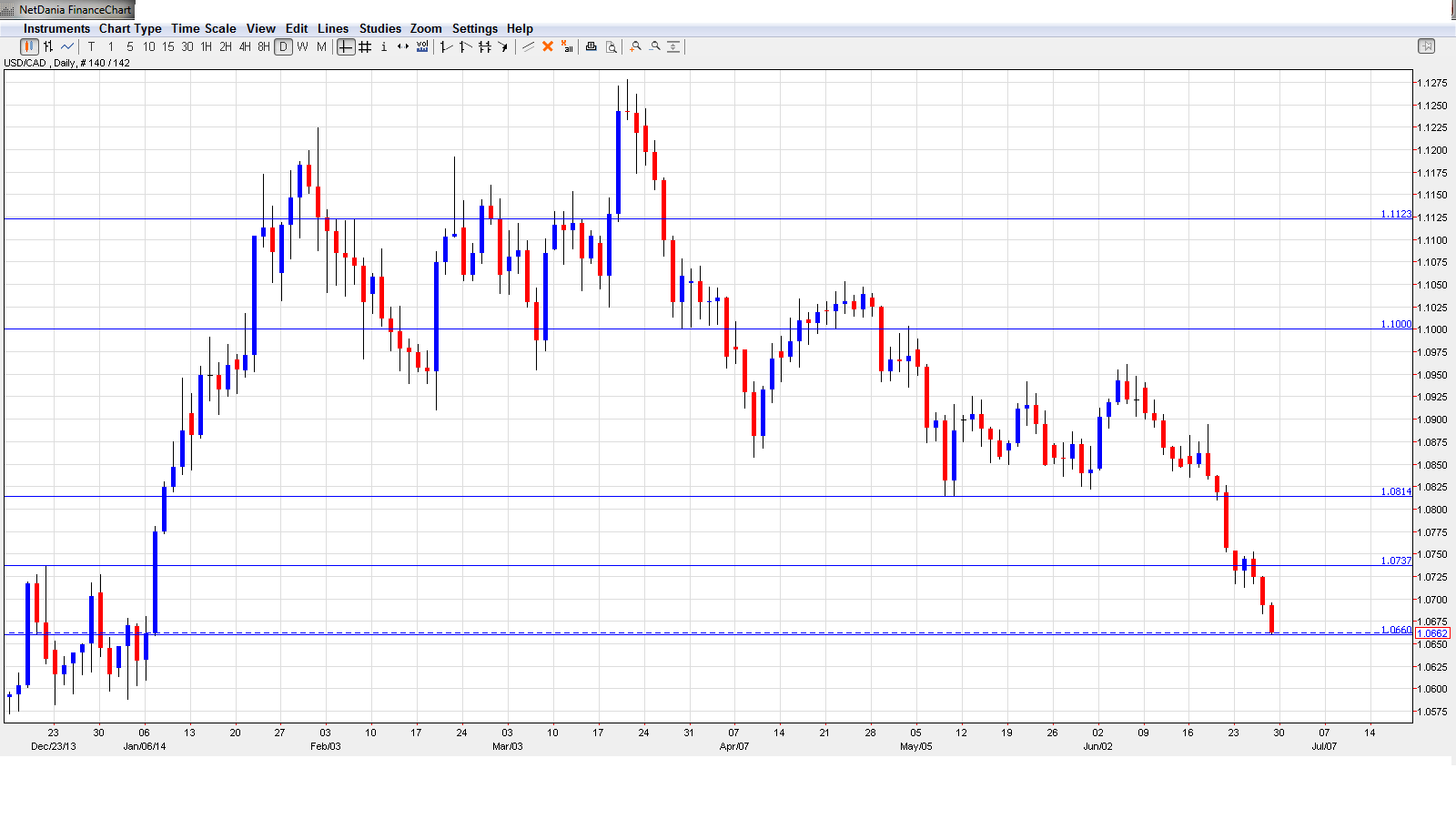
[do action=”autoupdate” tag=”USDCADUpdate”/] USD/CAD daily chart with support and resistance lines on it.Click to enlarge:
- GDP: Monday, 12:30. GDP is the primary gauge of economic activity and should be treated as a market mover. Unlike most other major economies, Canadian GDP is released on a monthly basis. The indicator has been dropping in recent months, and fell to 0.1% last month, matching the forecast. The markets are expecting a small gain on 0.2% in the upcoming release.
- Trade Balance: Thursday, 12:30. Trade Balance is closely linked to currency demand, as foreigners must purchase Canadian dollars in order to by Canadian exports. The indicator came in at -$0.6 billion in May, well off the estimate of -$0.2 billion and the first deficit since January. The estimate for the June release stands at -$0.3 billion.
* All times are GMT.
USD/CAD Technical Analysis
USD/CAD opened the week at 1.0753, which was the high of the week. The pair then dropped to the support level of 1.0660 (discussed last week), and closed the week at 1.0662.
Live chart of USD/CAD: [do action=”tradingviews” pair=”USDCAD” interval=”60″/]
Technical lines, from top to bottom:
We start with resistance at 1.1369. This line was breached in October 2008 as the US dollar posted sharp gains, climbing as high as the 1.21 level. This line has remained steady since July 2009.
1.1124 remains a strong resistance line. It has held firm since late March.
The psychological barrier of 1.10 has provided resistance since May, and has some breathing room with the Canadian dollar trading at higher levels. This is followed by resistance at 1.0945.
1.0815 started the week as a weak line but has some breathing room as the pair trades at lower levels.
1.0737 was easily breached by the pair and has reverted to a resistance role. This line was a cap in mid-2010, before the US dollar tumbled and dropped all the way into 0.93 territory.
1.0660 held firm in support as the Canadian dollar continues to trade at six-month lows. The pair saw a lot of activity in the second half of December.
1.0526 has been a strong support line since late November. 1.0422 was a key support line in mid-November.
1.0271 is the next support line. This line marked the start of a rally by the pair last October, which saw the US dollar climb above the 1.12 line.
1.0182 is the final support level for now. This line has held steady since September.
I am bullish on USD/CAD
The Canadian dollar continues to improve against its US counterpart. Can it continue the upward movement? The dismal US GDP could weigh on the greenback this week, so there is room for the loonie to gain further ground.
Further reading:
- For a broad view of all the week’s major events worldwide, read the USD outlook.
- For EUR/USD, check out the Euro to Dollar forecast.
- For the Japanese yen, read the USD/JPY forecast.
- For GBP/USD (cable), look into the British Pound forecast.
- For the Australian dollar (Aussie), check out the AUD to USD forecast.
- USD/CAD (loonie), check out the Canadian dollar.
 Share
Share