EUR/USD closed Q3 only marginally lower despite very nice volatility during this quarter. What’s in store for Q4?
The team at Deutsche Bank outlines 4 different states and an S-Curve:
Here is their view, courtesy of eFXnews:
In a recent note to clients, Deutsche Bank argues that now is not the time to ‘throw in the towel’ on the strong US dollar trade that in broad USD trade weighted terms likely has at least another 10% to go.
“It’s still far too early to throw in the ‘strong USD towel’. In the big picture, dollar strength continues to migrate. It started with the yen, moved to ‘the Fragile 5’, the EUR, commodity currencies, and the spotlight is now shining brightly on non-Japan Asia FX, with serious ramifications for most EM and commodity currencies,” DB argues.
DB outlines a framework for thinking about the USD, EUR/USD targets, and the differentiation between different states of risk appetite. The following are the 4 states constituting this framework along with DB’s EUR/USD forecasts over the coming months.
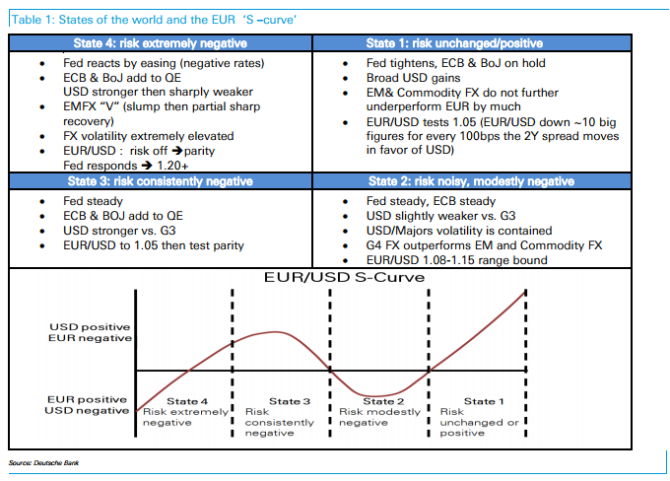
State 1: This state is risk neutral/positive. “The working assumption for much of the year was that the risk environment would not derail a Fed tightening cycle. In State 1, the data and risk appetite is constructive enough to allow for Fed tightening, while other G3 Central Banks are on hold. EUR/USD is then assumed to very roughly conform to the past response of going down ~10 big figures for every 100bp move in the 2yr USD – EUR spread,” DB argues.
State 2: has been the environment we have largely been operating in for the last few months. “Here risk related to market volatility is such that it delays the Fed, but is not sufficient to get the ECB and BoJ to add to their respective QE programs. In this instance EUR/USD tracks essentially sideways in the recent 1.08 to 1.15 range. Wide daily ranges prevail, but longer-term weekly/monthly ranges for G4 currency pairs prove relatively narrow. State 2 is when the EUR is negatively correlated with risky assets (like equities), but this will not last a shift into State 1 or State 3. In contrast, Commodity and EM underperform all G4 majors, and display elevated volatility,” DB adds.
State 3: is when risk is consistently negative – enough that not only does it keep the Fed steady but it propels the ECB and BOJ into action with more QE accommodation. “In this case EUR/USD tests the cycle low and probably extends to parity. Risk trades mostly negative, except immediately after the policy response. Note State 3 and State 2 may initially be difficult to separate. In State 3, the EUR is now hurt when risk is negative,” DB argues.
State 4: is if Risk Appetite turns exceedingly negative to the point where the Fed is driven to ease, quite possibly with QE4 and/or negative interest rates. “The BOJ and ECB also ease. The probability of entering this state is still a low delta. This resembles aspects of 2008, where the USD initially does very well in the ‘risk off’ phase, then weakens sharply with the Fed policy response, especially if it includes negative rates. EM FX does the reverse of the USD. EUR/USD goes to parity then back up above 1.20, and FX vol for both G10 and EM goes crazy,” DB projects.
DB targets EUR/USD at 1.05 by the end of the year, and at 0.98 by the end of Q1 2016.
For lots more FX trades from major banks, sign up to eFXplus
By signing up to eFXplus via the link above, you are directly supporting Forex Crunch.
 Share
Share