
Best No KYC Casinos in September 2026: Tested and Verified

 Share
Share
The best no KYC casinos open an account with an email and a deposit, not a document. They are offshore operators, licensed where they are based rather than by the regulator of the market a given reader sits in. A locally licensed casino verifies identity before a first withdrawal, every time, by rule. A no-KYC site trades that friction for speed and a lighter data footprint. “No KYC” is a signup property, not a lifetime guarantee. A check can still trigger later.
Every brand on this list is crypto-only. Withdrawals run on chain, not on a bank rail. The welcome offers range from a $1 entry to a 20,000 USDT headline. Wagering ranges from none to 80x. The list below ranks them by a mix of payout speed, bonus value and game depth.
Best No KYC Casinos

100% up to 1 BTC + 10% Weekly Cashback
100% up to 1 BTC + 10% Weekly Cashback
- Anonymous & VPN Friendly Casino
- Zero Fees, Instant Deposits & Withdrawals
- 5000+ Casino Games & Sports Betting Without Limit


150% up to $2,000
150% up to $2,000
- Over 4,000 games available
- Play on a fully anonymous platform with instant crypto withdrawals
- Seamless transactions with no hidden deposit and withdrawal fees

100% Match Bonus Up To 1 BTC + 10% Weekly Cashback
100% Match Bonus Up To 1 BTC + 10% Weekly Cashback
- Anonymous, VPN-friendly casino with no-KYC
- 10000+ most popular slots with weekly free spins
- No limits and instant deposits/withdrawals

150% Deposit Match + Up to 25% Weekly Cashback
150% Deposit Match + Up to 25% Weekly Cashback
- Token airdrop
- VPN friendly
- No KYC

Four Match Bonuses Up To $4,000 + 400 Free Spins
Four Match Bonuses Up To $4,000 + 400 Free Spins
- Huge range of regular promotions
- Bet on casino games, sports, lottery & bingo
- Wide range of payment methods
- Betpanda.io: best for a $1 minimum deposit
- Coinpoker Casino: best for rake-based bonus unlock
- Cryptorino: best for slot count
- CasinoPunkz: best for headline bonus size
- Hyper Lucky: best for no wagering
| # | Brand | Welcome offer | Wagering | Min deposit | Withdrawal time | Identity check at signup |
|---|---|---|---|---|---|---|
| 1 | Betpanda.io | 100% up to 1 BTC + 10% weekly cashback | 66x | $1 | 24h | No documents |
| 2 | Coinpoker Casino | 150% up to $2,000 | rake-based, ten 10% installments | $10 | 24h | No documents |
| 3 | Cryptorino | 100% up to 1 BTC + 10% weekly cashback | 66x, 7-day window | $10 | 24h | No documents |
| 4 | CasinoPunkz | 20,000 USDT + 15% cashback | 80x, ten increments | $20 | 1-48h | No documents |
| 5 | Hyper Lucky | 20% daily cashback up to $10,000 + 100 free spins | none | $10 | 1-24h | No documents |
The table quotes each brand’s published welcome offer, wagering multiple, minimum deposit, withdrawal window. The “Identity check at signup” column states whether documents are requested when the account opens. A 24h withdrawal window means the operator processes the request in that time. On-chain confirmation adds network time on top.
What a No KYC Casino Actually Is
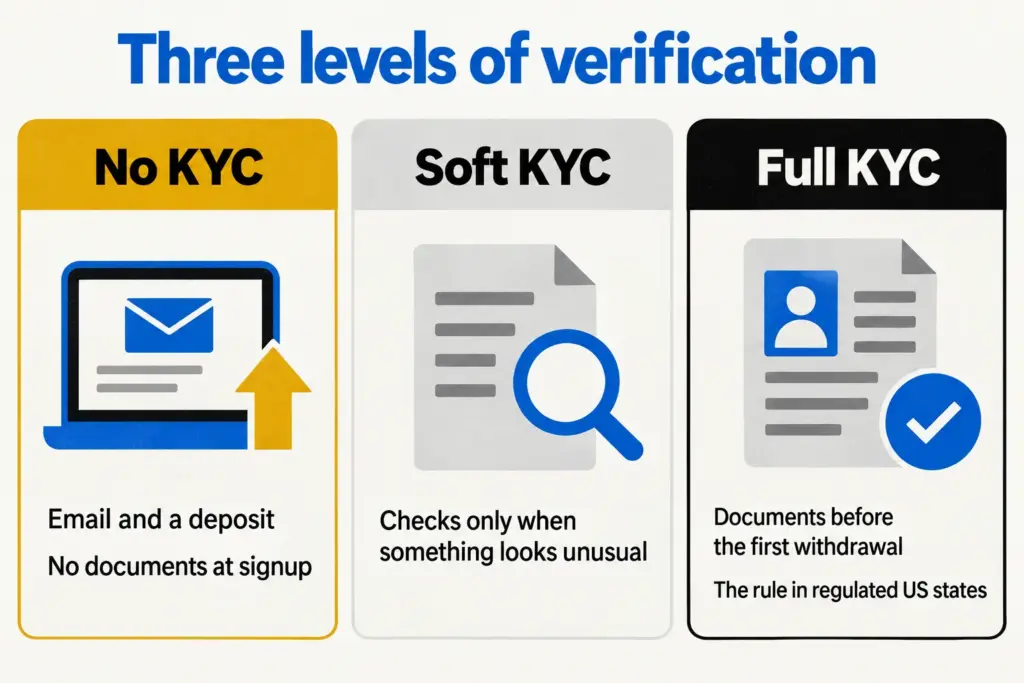
A no KYC casino opens an account with an email and a deposit. No photo ID at signup. No utility bill. No passport upload. The operator takes the deposit, lets the player play, and processes a withdrawal to a crypto wallet address without first demanding documents. That is what “no KYC” means in practice on the signup page.
A traditional, state-regulated US casino works differently. In the seven states that run live, state-regulated online casinos, a player must be 21 or older and must verify identity before a first withdrawal, every time, by rule. The contrast is the cleanest way to understand what a no-KYC offshore site is and is not. One model checks everyone up front. The other checks almost no one up front but keeps the option for later.
The records a no-document site holds are still real. The operator logs the IP address, device information, and the full transaction history from the moment of the first deposit. Monitoring runs on that data. Sudden changes in deposit or withdrawal pattern can trigger a review. A dispute or chargeback can trigger a review. Market-wide ranges reported across this category include withdrawals of $5,000 or more, a first deposit above roughly $2,000, and any dispute. Treat these as general ranges, not a rule, and never attribute them to one specific brand. They describe the category, not any single operator.
This is why the terminology matters. “No KYC casino” and “no verification casino” describe the signup step. “Anonymous casino” describes the player’s experience at the cashier, not a guarantee against all future checks. “Soft KYC” means checks only in unusual circumstances. “Full KYC” means documents at signup or before the first withdrawal. The five brands on this page sit in the no-KYC and soft-KYC tiers. None of them is a full-KYC operator.
What No KYC Does NOT Mean
The reader who arrives on this keyword looking for a way to stay invisible should read this section before any ranking. No KYC is not anonymity from the blockchain. The chain is a public ledger. The address you deposit from, the amount you send and the counterparty history are visible to anyone who looks. A no-KYC casino does not ask for your name, but the wallet address you use is recorded on-chain forever. Privacy from the operator is not privacy from the chain.
No KYC is not an exemption from the operator’s anti-money-laundering obligations in its licensing jurisdiction. An offshore operator still holds a licence somewhere. That licence comes with AML duties. The operator may not collect identity documents at signup, but it monitors transactions, flags patterns and reserves the right to request verification. Every brand on this page describes its signup as anonymous or no-KYC. None of the five brands guarantees in its terms that documents will never be requested. The terms reserve the right.
Verification can still be requested later. The typical triggers are a large withdrawal, a large first deposit, a sudden change in playing pattern, a dispute or a chargeback. The single most common trigger on an otherwise quiet account is a withdrawal address that does not match the deposit address. When a check opens, the documents asked for are photo ID, proof of address, sometimes proof of the payment method and occasionally a source-of-funds explanation. The balance normally stays locked while the check is open. A no-KYC signup delays a document request. It does not prevent one.
No KYC does not make winnings tax-free for a US player. All gambling winnings are taxable income in the US at every size, regardless of where the operator sits. An offshore operator issues no W-2G, so the reporting obligation falls on the player. The 2026 thresholds are further down this page.
No KYC is not a route around a state self-exclusion programme or a problem-gambling block. An offshore operator’s self-exclusion applies to that site alone. No state programme reaches an offshore account. A self-exclusion taken with a state-regulated operator does not transfer to an offshore site. A player who has self-excluded should read the absence of an ID check as a reason to stay away, not as a feature. The National Problem Gambling Helpline is 1-800-GAMBLER, call or text, 24 hours a day, 7 days a week, confidential across all 50 states.
Levels of Anonymity at a Casino
| Privacy expectation | Payout size that fits | Currency | Dispute recourse |
|---|---|---|---|
| No KYC | Small to mid withdrawals, crypto only | Crypto to a self-custody wallet | Limited to operator support |
| Soft KYC | Mid to larger withdrawals, checks only in unusual circumstances | Crypto, occasional fiat | Operator support, no external body |
| Full KYC | Any size, including large fiat withdrawals | Crypto and fiat, card and bank rails | Regulator and operator support |
A player who wants the no-KYC tier should also understand what recourse they give up. A state-regulated casino answers to a state gaming commission. A player with a complaint has a regulator to call. An offshore no-KYC operator answers to itself. The operator’s own terms govern the relationship, and the player’s recourse is the operator’s support channel. That is the trade. Faster signup, fewer questions, and no state regulator in exchange for a thinner safety net.
No licence jurisdiction, licence number or regulator is attributed to any of the five brands anywhere on this page, because none of them publishes that data here. What is true of the category is that these are offshore operators and none is licensed by a US state gaming regulator. A reader who wants more should read the operator’s own licence statement on the operator’s own site.
No KYC Casinos Reviewed
Betpanda.io Review
The headline welcome offer is a 100% match on the first deposit up to 1 BTC, plus a 10% weekly cashback. Minimum deposit is $1, the lowest in the set. Withdrawals process in 24h.
Wagering sits at 66x. A $100 deposit implies $6,600 of turnover before the bonus clears. The weekly cashback is wager-free, distributed on Wednesdays in the player’s main cryptocurrency, and can be withdrawn or replayed without restriction. The game library holds 5,000+ casino games plus a sportsbook.
The account is anonymous and VPN friendly, with instant deposits and withdrawals at zero fees. Casino and sports betting run without stated limits. No licence jurisdiction, coin list, or withdrawal cap is published for the brand.
Compared to Coinpoker Casino, Betpanda.io takes a $9 lower minimum deposit but matches it against a 66x wagering requirement where Coinpoker releases its bonus through rake. Against Cryptorino, the offer terms are identical but the library is half the size.
Pros:
- Lowest minimum deposit in the set at $1
- Wager-free weekly cashback paid every Wednesday
- 5,000+ casino games plus a sportsbook in one account
Cons:
- 66x wagering requires $6,600 of turnover on a $100 deposit
- No stated bonus expiry window, so terms must be checked on site
- No game-studio count or licensing details published
Coinpoker Casino Review
The welcome bonus is 150% up to $2,000, the largest fiat-denominated cap among the five. Minimum deposit is $10. Withdrawals process in 24h.
This is the one brand whose bonus unlock is driven by rake, not a wagering multiple. The bonus releases in ten installments of 10% each as rake requirements are met, with twice the bonus amount in rake overall. A player who deposits enough to claim the full $2,000 needs $4,000 in rake to unlock every increment. The library holds over 4,000 games. It runs as a fully anonymous platform with instant crypto withdrawals and no hidden deposit or withdrawal fees. The offer is for new players and first deposits only.
Against Betpanda.io, Coinpoker Casino takes a higher minimum deposit but caps the bonus in dollars rather than BTC. Against Hyper Lucky, Coinpoker carries a rake-based unlock where Hyper Lucky carries no wagering at all. A rake-based release only suits a player who plays poker volume.
Pros:
- 150% match up to $2,000 is the largest fiat cap in the set
- Instant crypto withdrawals with no hidden deposit or withdrawal fees
- Over 4,000 games in the library
Cons:
- Rake-based unlock requires twice the bonus amount in total rake
- $10 minimum deposit is nine times higher than Betpanda.io
- No game-studio count or licensing details published
Cryptorino Review
100% up to 1 BTC on the first deposit, plus a 10% weekly cashback. The wagering sits at 66x. A $100 deposit means $6,600 in turnover before the bonus clears. The same 66x multiple applies to Betpanda.io, so the two brands match on that front. Cryptorino pulls ahead on the library. The library runs to 10,000+ slots with weekly free spins. The largest slot count in the set. Betpanda.io carries 5,000+ games plus a sportsbook. Coinpoker Casino tops out at over 4,000 games.
The bonus expires. The requirement must be met within 7 days of the first deposit. Cryptorino is the only brand of the five with a stated bonus expiry. Miss the window and the bonus is gone. The bonus credits once the wagering requirement is met. Minimum deposit is $10. Betpanda.io takes $1. CasinoPunkz demands $20. The $10 floor at Cryptorino sits in the middle of the pack. Withdrawals process in 24h. Same as Betpanda.io and Coinpoker Casino. The site runs anonymous, VPN-friendly and no-KYC. No limits stated. Instant deposits and withdrawals.
The weekly cashback runs at 10 percent. No distribution day or payout currency is stated for Cryptorino’s cashback, only that the bonus is credited once the wagering requirement is met. A 10% weekly cashback matches Betpanda.io on the headline rate. Hyper Lucky offers 20% daily cashback up to $10,000 with no wagering instead. The account opens without documents. The identity check at signup reads as no KYC.
Pros:
- 10,000+ slots with weekly free spins gives the largest library in the set
- 24h withdrawal processing matches the fastest window among the five brands
- Weekly cashback is wager-free and paid in the player’s main cryptocurrency
Cons:
- 66x wagering with a 7-day expiry is the tightest bonus window in the set
- $10 minimum deposit is ten times the $1 floor at Betpanda.io
CasinoPunkz Review
20,000 USDT welcome bonus plus 15% cashback. The largest headline number in the set. The wagering is 80x, the highest of the five. A $100 deposit implies $8,000 of total turnover. Compare that to $6,600 at 66x for Betpanda.io and Cryptorino. The bonus pays in ten increments. Each increment unlocks after 8x the deposit has been wagered. The maximum bonus is $20,000 or crypto equivalent.
Minimum deposit is $20. The highest of the five. Betpanda.io takes $1. Cryptorino and Hyper Lucky take $10. The $20 floor activates the welcome bonus. Below that, no bonus. Withdrawals process in 1-48h. The widest window in the set. Betpanda.io, Coinpoker Casino and Cryptorino all process in 24h flat. Hyper Lucky runs 1-24h. The 1-48h range at CasinoPunkz adds a day of uncertainty at the top end. The account opens without documents. The site is no KYC and VPN friendly.
Free loot boxes drop daily. High stakes on Evolution blackjack tables are part of the pitch. No game count is published. Cryptorino lists 10,000+ slots. Betpanda.io lists 5,000+ games. Coinpoker Casino lists over 4,000. CasinoPunkz gives no count. The 15% cashback outpaces the 10% weekly cashback at Betpanda.io and Cryptorino. Hyper Lucky offers 20% daily cashback up to $10,000 with no wagering. The cashback at CasinoPunkz runs against 80x wagering on the deposit side.
Pros:
- 20,000 USDT headline bonus is the largest welcome offer among the five brands
- 15% cashback beats the 10% weekly cashback at Betpanda.io and Cryptorino
- Free loot boxes daily and high stakes on Evolution blackjack tables
Cons:
- 80x wagering is the highest in the set and $8,000 turnover on a $100 deposit
- $20 minimum deposit is the highest floor and activates the bonus only at that level
- 1-48h withdrawal window is the widest range among the five brands
Hyper Lucky Review
Hyper Lucky skips the matched-deposit format entirely. The welcome offer is 20% daily cashback up to $10,000 plus 100 free spins. No wagering requirement applies to the cashback. That makes it the only no-wagering offer among the five brands on this list. A $10 minimum deposit gets you in. Withdrawals process in 1 to 24 hours.
The daily cashback structure changes the math completely. A $100 deposit at a 66x site means $6,600 in turnover before the bonus clears. Here the same $100 deposit generates cashback daily with nothing to clear. The cap sits at $10,000 per day. Players who lose their deposit within the daily window get 20% back. The 100 free spins arrive alongside the cashback. The operator’s terms page holds the full breakdown.
The site is described as no KYC and VPN friendly. No documents are required to open an account. An email and a deposit get you playing. No game count is published. No sportsbook is listed.
The withdrawal window is wider than the top three. Betpanda, Coinpoker and Cryptorino all process in 24 hours flat. Hyper Lucky ranges from 1 to 24 hours. That means a withdrawal could land in under an hour or take a full day. CasinoPunkz has the widest window at 1 to 48 hours. Hyper Lucky sits between the flat-24h brands and that 48h ceiling.
The cashback has no wagering attached. You can withdraw it or replay it. Compare that to CasinoPunkz, where an 80x requirement on a $100 deposit means $8,000 in turnover before the full bonus unlocks. Hyper Lucky asks for none of that. The tradeoff is the headline number. CasinoPunkz advertises up to 20,000 USDT. Hyper Lucky advertises daily cashback up to $10,000. A player who wants a large upfront balance might prefer the bigger number. A player who wants to keep what they win without a multiplier will find the no-wagering structure cleaner.
Terms state 18 and over. Full terms live on the operator’s own site.
Pros:
- Only no wagering welcome offer in the set with 20% daily cashback up to $10,000
- No wagering requirement means cashback can be withdrawn immediately or replayed with no multiplier
- 100 free spins included alongside the daily cashback on a $10 minimum deposit
Cons:
- Withdrawal window of 1 to 24 hours is wider than the flat 24h processing at three other brands
- No published game count, so library size is not stated
- No matched deposit bonus means no large headline balance boost on the first deposit
Bonuses and Wagering at No-KYC Sites
Bonus terms at no-KYC sites cluster in a recognizable range. Wagering requirements typically land between 1x and 50x. Expiry windows run 7 to 30 days. Maximum bets while a bonus is live sit at roughly $5 to $10 per spin or hand. Those are market-wide patterns, not a rule for every site.
The five brands on this page sit at the top of that range and beyond. Betpanda.io carries a 66x wagering requirement on its 100% match up to 1 BTC. Cryptorino carries the same 66x, and adds a 7-day window to meet it. CasinoPunkz sits highest at 80x. A $100 deposit at 66x implies $6,600 of total turnover before the bonus clears. The same $100 deposit at 80x implies $8,000. Those numbers are the real cost of the headline offer.
The exceptions are where the value lives. Hyper Lucky offers 20% daily cashback up to $10,000 plus 100 free spins with no wagering requirement at all. It is the only no-wagering offer in the set. The cashback has no playthrough. Coinpoker Casino takes a different route. Its 150% match up to $2,000 releases in ten installments of 10% each as rake requirements are met, with twice the bonus amount in rake required overall. A rake-based unlock only suits a player who plays poker volume. A slots player will clear a traditional wagering multiple faster than a rake-based release.
Cashback terms vary in a way that matters. Betpanda.io pays 10% weekly cashback on Wednesdays in the player’s main cryptocurrency. That cashback is wager-free. It can be withdrawn without restriction or replayed in the casino. CasinoPunkz pairs its 20,000 USDT headline bonus with 15% cashback, but the bonus itself carries that 80x requirement, paid in ten increments, with each increment unlocking after 8x the deposit has been wagered. The headline number is roughly ten times the $2,000 cap on Coinpoker Casino’s offer, but the wagering cost is the highest in the set.
A worked example makes the comparison concrete. A player deposits $100 at Betpanda.io. The 100% match adds $100 in bonus funds. The 66x requirement applies, meaning $6,600 of total turnover before the bonus converts to withdrawable cash. If that player instead deposits $100 at Hyper Lucky, there is no match bonus, but the 20% daily cashback up to $10,000 has no wagering attached. A player who loses $100 on day one receives $20 back with no playthrough. The player who values a large headline match accepts a high turnover cost. The player who wants cash they can withdraw immediately takes the no-wagering cashback.
Cryptorino’s 7-day window is the tightest expiry in the set. The 66x requirement is the same as Betpanda.io’s, but the clock starts at the first deposit. A player who deposits on a Friday and does not play until Tuesday has already burned four of the seven days. The bonus is credited once the wagering requirement is met, not at the moment of deposit. That detail changes the math. A player who cannot commit to heavy play in the first week should treat the 7-day window as a real limitation, not a footnote.
Reading bonus terms before depositing is the single most useful habit on this page. The wagering multiple, the expiry, the increment structure, and the cashback terms are the four variables that determine whether a headline number is worth claiming. A 20,000 USDT bonus at 80x is a different product from a 1 BTC bonus at 66x with wager-free weekly cashback. Both can be worth it. Neither is free money.
How Verification Works When It Is Triggered
A no-KYC casino runs on crypto rails. You open an account with an email, send a deposit from a wallet you control, and play. When it is time to withdraw, the operator sends funds back to a wallet address. No photo ID at signup. No utility bill. No source-of-funds letter. That is the pitch, and for the five brands on this page the first part is true at signup. What happens when it is not true is where the real risk lives.
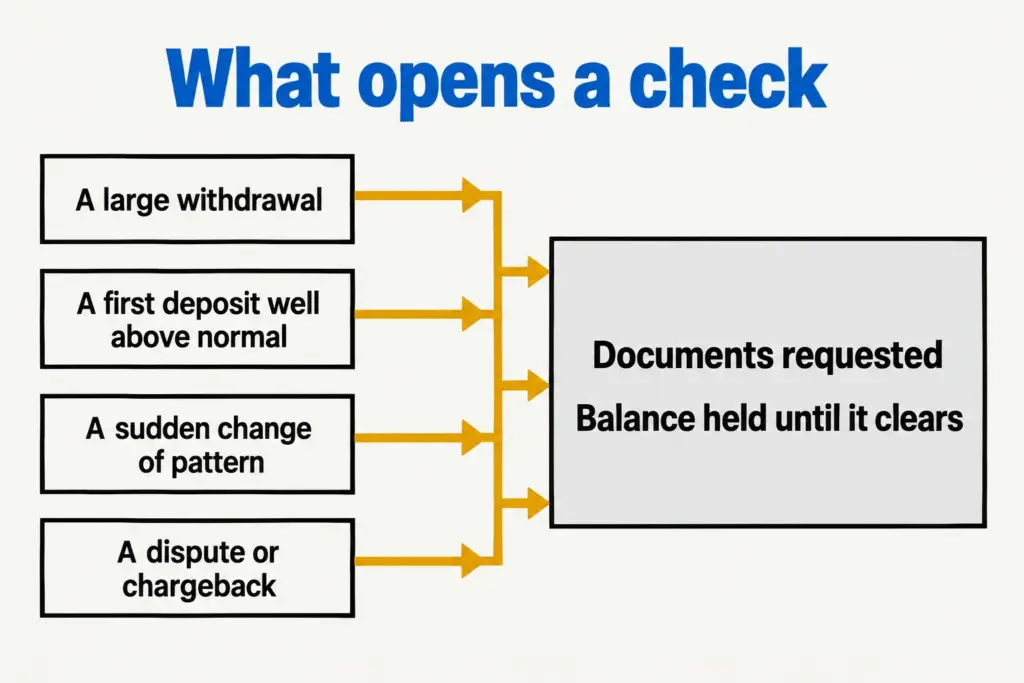
A verification request can open at any point after signup. The most common trigger on an otherwise quiet account is a withdrawal address that does not match the deposit address. The operator’s system flags the mismatch as a fraud-control measure, not a regulatory demand. A large withdrawal can trigger a check. Withdrawals of $5,000 or more, a first deposit well above the site’s norm, a sudden change in pattern and any dispute or chargeback are the market-wide triggers.
When a check opens, the documents asked for typically include photo ID, proof of address, sometimes proof of the payment method and occasionally a source-of-funds explanation. Photo ID means a passport, a driver’s licence or a national identity card. Proof of address means a utility bill or a bank statement, usually dated within the last three months. Proof of the payment method means a screenshot of the wallet showing the deposit address. A source-of-funds explanation can mean a payslip, a business-records letter or a sale-of-assets receipt. The depth of the request varies with the size of the withdrawal and the pattern that triggered it.
The balance normally stays locked while a check is open. The operator suspends withdrawals from the account until the documents are reviewed and cleared. The player can sometimes still deposit and play during the review, but cannot withdraw. The turnaround is not standardized. The operator sets its own timeline. A reader who understands this before depositing is better served than one who discovers it after a win.
The deposit-wallet and withdrawal-wallet mismatch deserves separate attention because it is the single most common trigger. The operator records the address you deposit from at signup. When you request a withdrawal to a different address, the system flags the change. The check that follows is a fraud-control measure. A player who uses the same address for both directions is less likely to trigger it. The page does not advise on structuring transactions to avoid a check. It states what triggers one so the reader knows in advance.
The five brands on this page open the account without documents. Every one of them reserves the right in its terms to request verification later. The reader who treats no-KYC as a lifetime guarantee will be surprised. The reader who treats it as a signup property will not be.
Deposits land when the blockchain confirms them. Bitcoin blocks arrive about every 10 minutes, and six confirmations take roughly 60 minutes. Litecoin cuts that to 2.5-minute blocks with fees close to zero. Solana settles in under a second at an average fee of about $0.00025. Ethereum processes blocks in 12 to 14 seconds, and a $100 stablecoin transfer can cost a few dollars in a busy block. Lightning finishes in under a second for typically under 100 satoshis. The operator does not control these times. The network does.
Every chain named here is pseudonymous, not anonymous. The address, the amount, and the counterparty history are public forever. A casino that does not ask for your documents still sees the wallet address you deposit from and the address you withdraw to. If you later send those funds to an exchange account that is verified, the trail re-links to a named person.
Withdrawal speeds on this page range from 24 hours flat to a 1 to 48 hour window. Betpanda.io, Coinpoker Casino, and Cryptorino all process in 24h. Hyper Lucky runs 1 to 24h. CasinoPunkz has the widest stated window at 1 to 48h. These are processing times, meaning the operator’s internal handling. The actual landing time depends on the network confirmation speed above. A 24h processing window plus 60 minutes of Bitcoin confirmations means the funds hit your wallet in roughly 25 hours.
The deposit and withdrawal addresses matter. The most common reason a check opens on an otherwise quiet account is a withdrawal address that does not match the deposit address. The operator’s system flags the mismatch. This is not a KYC request at signup. It is a fraud-control trigger that can lead to a document request later. A reader who knows that in advance is better served than one surprised by it after a win.
Deposits and Withdrawals Without an Account Check
The brands on this page advertise zero fees on deposits and withdrawals. The blockchain fee still applies. Bitcoin on-chain fees range from a couple of thousand satoshis to tens of thousands depending on mempool congestion. A Lightning withdrawal costs under 100 satoshis. Litecoin runs close to zero. Solana averages about $0.00025. Ethereum can cost a few dollars on a $100 stablecoin transfer in a busy block. USDT on TRON runs about 6.5 TRX, roughly $2.08, to a wallet already holding USDT, or 13 TRX, about $4.16, to a fresh one. Renting energy on TRON costs 3 to 5 TRX. You pick the chain, you pick the fee tier. The casino does not set the network cost.
Confirmation counts determine when a deposit is credited. Bitcoin blocks arrive about every 10 minutes. Six confirmations take roughly 60 minutes. Litecoin blocks arrive about every 2.5 minutes, so six confirmations take about 15 minutes. Ethereum processes blocks in 12 to 14 seconds. Solana settles in under a second. Lightning settles in under a second. The operator waits for a set number of confirmations before the deposit shows in the account balance. The faster the chain, the sooner the deposit is playable.
None of the five publishes a withdrawal limit for unverified accounts. None of the five publishes a minimum or maximum withdrawal amount, a daily cap or a monthly cap. That absence is itself a fact. A reader who plans to withdraw a large balance should check the operator’s own terms page for the limit that applies to an unverified account before depositing, not after. A traditional, state-regulated casino publishes its withdrawal limits because a regulator requires it. An offshore no-KYC operator is not compelled by a US regulator to publish them, and none of the five does.
The withdrawal windows on this page are processing times, not landing times. Betpanda.io, Coinpoker Casino and Cryptorino process in 24h flat. Hyper Lucky processes in 1 to 24h. CasinoPunkz processes in 1 to 48h. Processing means the operator’s internal handling. The actual landing time depends on the network confirmation speed. A 24h processing window plus 60 minutes of Bitcoin confirmations means the funds hit the wallet in roughly 25 hours. A 24h processing window plus a Lightning withdrawal means the funds land in roughly 24 hours and one second. The chain is the variable the player controls. The processing window is the variable the operator sets.
The best crypto casinos treat deposits and withdrawals as the same rail in both directions. You send to the address the operator provides, you withdraw to the address you provide. The simplicity is the product. The risk is that a public ledger records every step, and a mismatch between your deposit and withdrawal addresses is the single most likely event to turn a quiet account into a reviewed one.
Privacy in Practice at a No KYC Casino
Privacy at a no-KYC casino is not one thing. It is a set of trade-offs across the operator, the chain, the wallet and the network. The reader who wants to understand what is and is not private should look at each layer separately.
What the Operator Can See
The operator does not ask for your name at signup, but it records what it can. The IP address is logged at every session. Device information is logged, including browser type, operating system and screen resolution. The full transaction history is recorded from the moment of the first deposit. Monitoring runs on that data. A sudden change in deposit pattern, a new device, a login from a country not seen before can all flag the account. The operator does not need a name to monitor behavior. It needs an address, a device and a pattern, and it has all three.
What the Chain Shows Anyone
The blockchain is a public ledger. Every chain a crypto casino uses is pseudonymous, not anonymous. A player who deposits from a wallet and withdraws to the same wallet leaves a continuous trail. A player who withdraws to an exchange account that is itself verified re-links the trail to a named person at that point. The casino’s privacy policy does not change what the chain records. The chain records everything.
Custodial Versus Non-Custodial Wallets
A custodial wallet holds funds with a third party that controls the private keys. The third party knows the identity behind the account, because it performed KYC when the account opened. A withdrawal to a custodial wallet re-links the on-chain trail to a named person at the exchange. A non-custodial wallet gives the player full control of the keys. The player generates the address, signs the transaction and the casino never holds the keys. The trade-off is that losing the seed phrase means losing access to the funds. No support desk can reset it. For play at a no-KYC site, a non-custodial wallet is the standard choice because it does not introduce a named intermediary into the transaction trail.
What a VPN Clause in the Terms Means for a Balance
All five brands on this page describe themselves as VPN friendly. A VPN clause in the terms means the operator does not block logins from a VPN or penalize accounts that use one. It does not mean the operator cannot see the VPN IP address. It does not mean the VPN protects the balance from a fraud-control review. The operator still logs the IP, the device and the transaction history. A VPN changes the IP. It does not change what the chain records. A player who reads the VPN-friendly line as a privacy guarantee is overreading it.
Why a Privacy Coin Is Not a Solution the Operator Will Thank You For
A privacy coin like Monero obfuscates the sender, the receiver and the amount on-chain. A player who deposits in a privacy coin and withdraws in the same coin removes the on-chain trail the operator’s monitoring relies on. The operator cannot verify the source of funds from the chain. That is the point at which a source-of-funds document request becomes more likely, not less. A privacy coin does not keep the operator quiet. It does the opposite. It removes the on-chain evidence the operator uses to clear the account, and the operator replaces that evidence with a document request. The reader who sees a privacy coin as a route to invisibility is reading the wrong page.
No KYC Casinos vs Traditional Casinos
A traditional online casino verifies identity before the first withdrawal. Every time, by rule. A state-regulated US casino checks your name, address, date of birth, and Social Security number against a database before you can deposit, and it checks again before a payout. A no-KYC casino opens the account with an email and a deposit. The contrast is sharp, and it is the cleanest way to understand what each type does and does not do.
| Feature | No KYC Casino | Traditional Casino |
|---|---|---|
| Registration | Email and deposit | Full identity verification |
| First deposit | Wallet to wallet | Card, bank, or wallet |
| Withdrawal trigger | Request to a wallet address | ID check before payout |
| Dispute recourse | Operator terms only | Regulator and operator |
| Deposit limits | Set by the operator | State-mandated floors |
| Self-exclusion | Site only | State programme available |
| Tax forms | No W-2G issued | W-2G for qualifying wins |
The most obvious contrast shows up at sign-up. Creating a no-KYC account takes less than a minute, while a traditional account may require a day or longer when the identity verification runs into complications. The less visible contrast concerns accountability. A state-regulated casino is answerable to a gaming commission, whereas a no-KYC offshore operator is answerable only to its own terms. Should a dispute occur at a traditional casino, a regulator can step in. At a no-KYC site, the operator’s published terms are the final word.
Banking tells a similar story. Traditional casinos accept cards and bank transfers because they operate within the US financial system. No-KYC casinos run on crypto because crypto does not require a bank to move funds between a player and an operator. The deposit is a wallet-to-wallet transfer. The withdrawal is the same in reverse. A $100 bank transfer at a traditional casino can take three to five business days. A $100 crypto withdrawal at a no-KYC site processes in 24 hours, then lands after network confirmations.
Limits differ in kind. A traditional casino posts state-mandated minimums and maximums. A no-KYC operator sets its own. The brands on this page range from a $1 minimum deposit at Betpanda.io to a $20 minimum at CasinoPunkz. No withdrawal limits or caps are published for any of the five. A traditional casino publishes both because a regulator requires it.
Self-exclusion is the area where the gap matters most. A state-regulated casino can enroll you in a programme that reaches every licensed operator in that state. An offshore operator’s version covers that one site. No state programme reaches an offshore operator, and a block taken with a state-regulated one does not travel. A player who needs a block should know that before they sign up anywhere.
Taxes close the comparison. A traditional casino issues a W-2G once a win clears the threshold; an offshore operator issues nothing at all, and the reporting obligation lands on the player in both cases. The 2026 thresholds and the new cap on loss deductions are set out in the legality section below. The crypto news desk follows reporting and compliance changes as they happen.
The choice between the two models is a choice between speed and structure. A no-KYC casino gives you a fast signup, a crypto-only banking rail, and operator terms as the final authority. A traditional casino gives you a slower onboarding, a regulated banking rail, and a commission that can hear a dispute. Neither model is invisible. A no-KYC site records your IP, device information, and full transaction history. A traditional site records your identity and the same history. The ledger is different. The surveillance is not.
Players who follow crypto day trading strategies often already understand wallet management, confirmation times, and fee tiers. Those skills transfer directly to deposit and withdrawal timing at a no-KYC casino. The player who does not know the difference between a custodial and a non-custodial wallet, or who has never waited for six Bitcoin confirmations, has a steeper learning curve. The mechanics are not hard. They are just new if you have only ever used a card.
The final difference is age. The offshore sites on this page are 18+. State-regulated US casinos are 21+. A reader who is 19 can open an account at an offshore operator but cannot enter a state-regulated online casino in any of the seven live jurisdictions. That age gap is not a loophole. It is a different rule set applied by a different authority to a different type of business.
18+. The casinos on this page are offshore operators, licensed where they are based rather than by the regulator of your own market. An account opened without documents is not an anonymous account: the operator records the IP address, the device and every transaction, the blockchain records the rest, and verification can still be requested later.
No KYC is not a way around a self-exclusion. An offshore operator’s block covers that site alone, and a block taken with a locally licensed operator does not travel. If gambling stops being entertainment, use your national helpline; in the US that is 1-800-GAMBLER, call or text, 24 hours a day, free and confidential in all 50 states.
Is It Legal to Play at a No KYC Casino
Online gambling law is national, and in almost every market it binds the operator rather than the player: running an unlicensed casino is the offence, placing a bet at one usually is not. What varies is the recourse a reader keeps, and a handful of jurisdictions do reach the player. The United States is the worked example below, because its rules are the strictest and these five brands sit on its offer list.
US federal law does not create a player offence for placing a bet online. The Unlawful Internet Gambling Enforcement Act of 2006 targets the businesses that accept payments connected to unlawful internet gambling, not the individual sitting at the keyboard. The Wire Act reaches interstate wire communications for sports betting. Neither statute makes a player a criminal for spinning a slot at an offshore site.
State law is where the picture gets uneven. Seven states have live, state-regulated online casinos: New Jersey, Delaware, Pennsylvania, Michigan, West Virginia, Connecticut and Rhode Island. Every one of them sets the entry age at 21 and verifies identity before a first withdrawal, every time, by rule. Maine legalised online casino gaming in January 2026 under LD1164 but has not launched. Nevada permits online poker only.
Washington is the outlier a reader on this keyword needs to know about. RCW 9.46.240 makes knowingly transmitting or receiving gambling information over the internet a class C felony. On its face that reaches the player. The penalty is up to five years and a $10,000 fine. No prosecution of an individual player is on record, but the statute exists and a reader in Washington should know it before they open an account anywhere offshore.
None of the five brands on this page is licensed by a US state gaming regulator. State-regulated casinos verify identity because state law requires it. A no-KYC operator opens an account with an email and a deposit because no US regulator is compelling it to do otherwise. The contrast is the cleanest way to understand what a no-KYC site is and what it is not.
A Curacao licence or a Curacao-adjacent operating permit is common in this category, but none of the five brands here is credited with one, because none of them publishes the detail. The honest instruction is to check the operator’s own licence statement on its site before you deposit. If the operator does not publish a licence number, a regulator name and a registered company, that absence is a red flag on its own.
Tax is separate from legality and applies regardless of where the operator sits. All gambling winnings are taxable income in the US at every size. An offshore operator issues no W-2G. No W-2G does not mean no tax. It means no form. The operator’s terms govern your account. US tax law governs your return.
This is general information, not legal advice. Check the operator’s own terms and the law of your state before you play.
How We Ranked the Best No KYC Casinos
Welcome bonus value is the first comparison. The ranking rewards a large headline offer measured against the stated wagering multiple. A 100% match up to 1 BTC with 66x wagering scores well. A 20,000 USDT headline with 80x wagering scores well on size but loses ground on the turnover it demands. A 20% daily cashback with no wagering requirement scores well on simplicity. The ranking compares the dollar value of the offer to the turnover a $100 deposit implies, and favours a clear path to withdrawal.
Minimum deposit sets the barrier to entry. The ranking compares the floor at each brand. One brand opens the door at $1. Three brands sit at $10. One brand asks for $20. A lower minimum lets a reader test the cashier, the withdrawal speed and the platform before committing meaningful funds. The ranking rewards a low entry point and notes the highest one plainly.
Withdrawal speed is the payout test that matters most to a reader on this keyword. The ranking compares the published processing window at each brand. A flat 24h window scores well. A 1-24h window scores well. A 1-48h window is the widest in the set and the ranking names it as a drawback. Speed is stated as a published figure, not a timed test.
Game library size shows what a reader gets for their deposit. The ranking compares the published game counts. A library of 10,000+ slots is the largest in the set. A library of 5,000+ casino games plus a sportsbook adds a second product. A library of 4,000+ games is solid. The ranking rewards scale and variety, and notes when a brand publishes no count at all.
Bonus terms and expiry are where the ranking separates similar offers. A 7-day window to clear 66x wagering is short and the ranking says so. A rake-based unlock in ten 10% installments suits a player who plays poker volume. A wager-free weekly cashback distributed on a set day in the player’s main cryptocurrency is the easiest term in the set. The ranking rewards terms a reader can actually meet, and penalises a short expiry or an 80x multiplier without apology.
How to Judge a No KYC Casino Yourself
A reader who wants to evaluate a no-KYC casino on their own should use a checklist with numbers. The brands on this page pass most of these tests. A brand that fails more than two should be treated with caution.
1. Published licence statement. The operator should state which authority issued its licence, the licence number and the registered company name on its own site. None of the five brands on this page is licensed by a US state gaming regulator, and none publishes its licensing detail here. The honest instruction is to read the operator’s own licence page before depositing. If no licensing information appears anywhere, that is a red flag.
2. Minimum deposit under $50. The brands on this page range from $1 at Betpanda.io to $20 at CasinoPunkz. A minimum deposit above $50 is not necessarily a scam, but it raises the barrier to testing the cashier and the withdrawal process before committing meaningful funds. The five brands on this page all clear this bar.
3. Stated withdrawal window. A withdrawal window is published for every brand on this page. Betpanda.io, Coinpoker Casino and Cryptorino process in 24h. Hyper Lucky processes in 1 to 24h. CasinoPunkz processes in 1 to 48h. An operator that publishes no withdrawal window at all leaves the player guessing. The widest window in the set, 1 to 48h, is still a stated figure. No stated figure is worse than a wide one.
4. Bonus terms stated before deposit. The wagering multiple, the expiry, the increment structure and the cashback terms should appear in the operator’s own terms. The brands on this page publish all of these. Betpanda.io carries 66x. Cryptorino carries 66x with a 7-day window. CasinoPunkz carries 80x in ten increments. Coinpoker Casino releases in ten 10% installments against rake. Hyper Lucky carries no wagering at all. A bonus whose terms are not stated before deposit is a bonus whose cost is unknown.
5. No forced custodial deposits. The operator should let the player deposit from a wallet the player controls. A forced custodial deposit, where the player must hold funds with the operator before playing, is standard at every casino on this page, but it should come with a published withdrawal policy. No published withdrawal policy alongside a forced custodial deposit is a red flag.
6. Published game count or library description. A game count is published for three of the five brands: 10,000+ slots at Cryptorino, 5,000+ games plus a sportsbook at Betpanda.io, and over 4,000 games at Coinpoker Casino. CasinoPunkz and Hyper Lucky publish no count. An operator that gives no indication of library size is not necessarily dishonest, but the reader has less to evaluate.
7. Responsible-gambling tools on site. The operator should offer deposit limits, session limits and self-exclusion. An offshore operator’s tools apply to that site alone. No state programme reaches them. A reader who needs a block should know that. The National Problem Gambling Helpline is 1-800-GAMBLER, call or text, 24 hours a day, 7 days a week, confidential across all 50 states.
Frequently Asked Questions
All five brands on this page open an account without identity documents at signup. Betpanda.io, Cryptorino, CasinoPunkz and Hyper Lucky are described as no-KYC or anonymous. Coinpoker Casino is described as a fully anonymous platform. Each opens the account with an email and a deposit. None of the five asks for photo ID at signup. The account is pseudonymous, not anonymous, and a later check remains possible.
Yes. No KYC is a signup property, not a lifetime guarantee. Market-wide trigger points include withdrawals of $5,000 or more, a first deposit above roughly $2,000, sudden changes in pattern and any dispute or chargeback. A withdrawal address that does not match the deposit address is the most common trigger on an otherwise quiet account. When a check opens, the documents asked for are photo ID, proof of address and sometimes a source-of-funds explanation. The balance normally stays locked while it is open.
No. The casino does not ask for your name at signup, but it records the IP address, device information and the full transaction history. The blockchain is a public ledger. The address, the amount and the counterparty history are public forever. A withdrawal to an exchange account that is verified re-links the trail. Every chain used here is pseudonymous, not anonymous. Privacy from the casino is not privacy from the chain.
Yes. In the US, all gambling winnings count as taxable income no matter the amount, even when no form is issued. An offshore operator sends no W-2G, but the absence of a form only means the form is missing, not that the tax goes away. For the 2026 tax year, the W-2G threshold for slot wins stands at $2,000, up from $1,200 and indexed going forward. Under the One Big Beautiful Bill Act, the deduction for wagering losses is capped at 90% of those losses and remains limited to reported winnings. Maintain your own records and report every win.
That depends on the operator. Red flags include no licensing or operator information anywhere on the site, forced large first deposits, bonus terms that are not stated, forced custodial deposits with no withdrawal policy published and no published withdrawal limits. The brands on this page publish their bonus terms, minimum deposits and withdrawal windows. None is licensed by a US state gaming regulator. Read the operator’s own licence statement and terms before you deposit.
They monitor the data they do hold. Even at a no-document site the operator records the IP address, device information and the full transaction history. Monitoring runs on that data and on the on-chain wallet activity. A mismatch between the deposit address and the withdrawal address is the single most common reason a check opens. A large withdrawal, an unusually large first deposit or a dispute can also trigger one. The balance stays locked while the check is open.
Verdict
Betpanda.io takes the top slot for the clearest reason in the set. A $1 minimum deposit opens the account, withdrawals process in 24h, and the 10% weekly cashback lands every Wednesday with no wagering attached. The 66x rollover on the welcome bonus is real money, but a player who skips the bonus and plays for cashback faces none of it. Cryptorino is the runner-up. It shares the 100% up to 1 BTC offer, the 66x wagering and the 24h payout speed, but its 10,000+ slot library is the largest in the set and its 7-day bonus window is the tightest. A player who wants volume and can clear 66x in a week should look there first. Hyper Lucky stands apart for anyone who will not touch a wagering requirement: 20% daily cashback up to $10,000 plus 100 free spins, with no rollover at all.
Responsible Gambling
The offshore sites on this page are 18+. State-regulated US casinos are 21+. That age gap reflects a different rule set applied by a different authority, not a loophole.
Deposit limits, session limits and self-exclusion are the three tools an offshore operator typically offers. A deposit limit caps how much you can fund the account in a set period. A session limit caps how long you can stay logged in. Self-exclusion closes the account for a period you choose. An offshore operator’s self-exclusion applies to that site alone. No state programme reaches it. A self-exclusion taken with a state-regulated operator does not transfer to an offshore site. A player who has self-excluded should read the absence of an ID check at a no-KYC casino as a reason to stay away, not as a feature.
What an offshore operator’s tools do not cover is the part a reader on this keyword needs to hear plainly. The tools do not cover other offshore sites. The tools do not reach a state-regulated operator’s account. The tools do not block crypto payments at the wallet level. The tools do not prevent a new account at a different offshore site with a different email. A self-exclusion with one operator is a single-site lock, not a category-wide block.
A player who wants broader protection has options. The National Problem Gambling Helpline is 1-800-GAMBLER. Call or text. It runs 24 hours a day, 7 days a week, confidential across all 50 states. The helpline connects callers to local resources, including state self-exclusion programmes where they exist. A reader who is concerned about their own play or someone else’s can call without giving a name.
State self-exclusion programmes exist in the seven live state-regulated markets and in several states without live online casinos. Enrolling in one reaches every licensed operator in that state. It does not reach an offshore site. A reader who wants to block offshore access should know that no US programme currently does that, and should call 1-800-GAMBLER for guidance specific to their situation.
This is general information, not legal advice. Check the operator’s own terms and the law of your state before you play.
Saqib Iqbal

