The US dollar has strengthened after the excellent jobs report. But can it continue? The team at Morgan Stanley has their doubts:
Here is their view, courtesy of eFXnews:
Markets are now questioning the effectiveness of monetary easing (rate cuts or QE) to be able to weaken currencies. In particular, JPY and EUR come to mind where both the BoJ and ECB eased further in January and March yet saw their currencies strengthen afterwards.
Our analysis on whether monetary easing can weaken currencies going forward is now based on the ability to bring down long-term bond yields.Previously currencies were able to weaken for two primary reasons outside of yield reductions, but these ideas are now reaching limits. First, there was a rise in inflation expectations from the belief that monetary easing would work. Second, forward guidance provided by the central banks on the room for further rate cuts or other easing measures such as QE was considered to be credible and doable, so the market priced in this future balance sheet expansion expectation via weakening the currency.
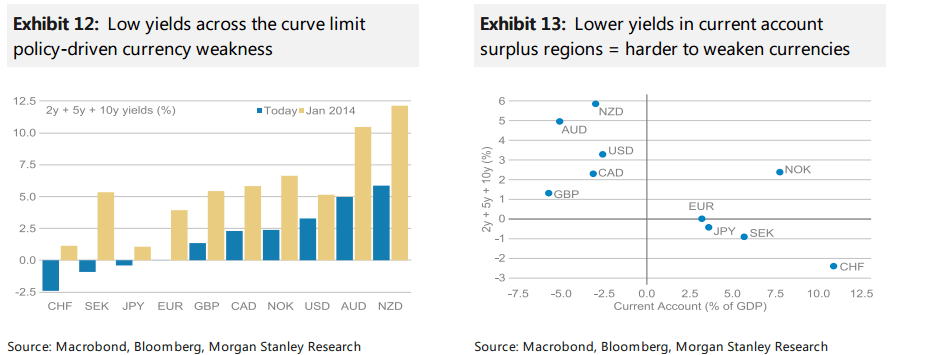
Bottom line: Flat yield curves, low inflation expectations and reaching the bottom bound in rates are limiting the ability of central banks to weaken currencies.
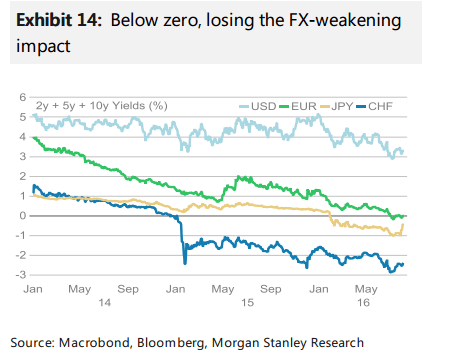
We define an indicator to monitor when central banks may reach these limits, taking the sum of the 2y + 5y +10y nominal bond yields.When this indicator drops below zero, we suggest that the central bank has ‘exhausted the yield curve,’ meaning the monetary easing policy needs to be perceived to increase inflation expectations to weaken currencies.
For these reasons, we remain bullish on EUR and JPY.
For lots more FX trades from major banks, sign up to eFXplus
By signing up to eFXplus via the link above, you are directly supporting Forex Crunch.
 Share
Share