GBP/USD posted sharp losses for a second week, dropping 135 points. The pair closed the week at the 1.4250 line, its lowest weekly close in eight weeks. There are 9 events this week. Here is an outlook on the major events moving the pound and an updated technical analysis for GBP/USD.
In the US, Janet Yellen gave a cautious speech and didn’t mention a timetable regarding a rate hike. US employment numbers bounced back after the awful NFP report, as JOLT Job Openings and Unemployment Claims beat expectations. Over in the UK, Manufacturing Production impressed with a gain of 2.3%, well above expectations.
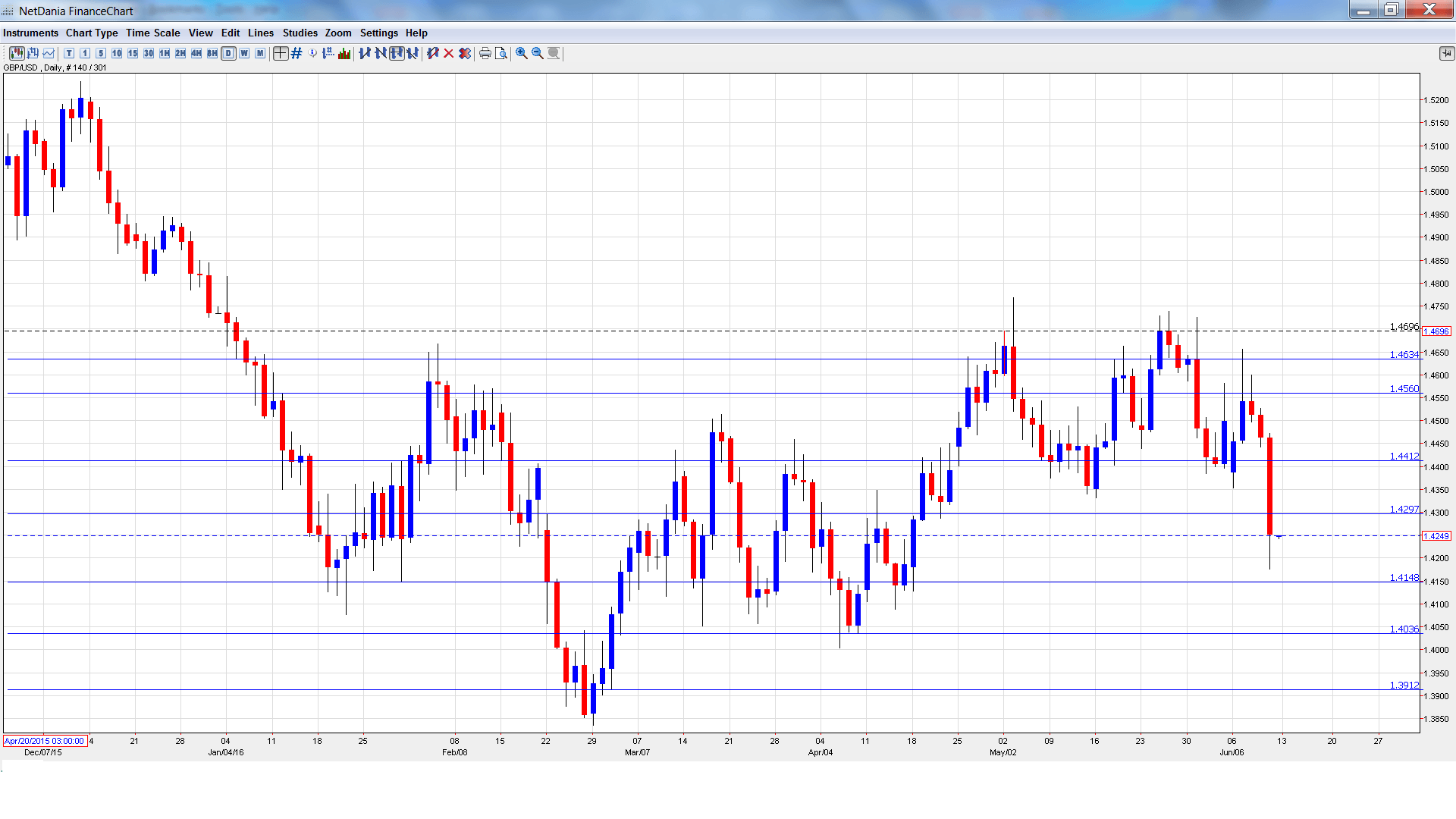
[do action=”autoupdate” tag=”GBPUSDUpdate”/]GBP/USD graph with support and resistance lines on it. Click to enlarge:
- CB Leading Index: Monday, 13:30. This indicator is a minor event, as most of the data has been previously released. The index dipped to 0.0% in March, marking a 5-month low.
- CPI: Tuesday, 8:30. CPI is the primary gauge of consumer inflation, and is closely tracked by the BoE. In April, the index dipped to 0.3%, short of the estimate of 0.5%. Little change is expected in the May release.
- PPI Input: Tuesday, 8:30. This important manufacturing indicator posted a gain of 0.9% in April, within expectations. However, it was sharply lower than the previous reading of 2.0%. The estimate for the May report stands at 0.9%
- RPI: Tuesday, 8:30. RPI includes housing costs, which are excluded from the CPI report. The index has been fairly steady, posting gains of 1.3% in three of the past four releases. The markets are expecting a slight improvement in May, with an estimate of 1.5%.
- Average Earnings Index: Wednesday, 8:30. This indicator measures wage growth, which plays an important role in evaluating the strength of the labor market. In March, the indicator improved to 2.0%, beating the estimate of 1.7%. The April forecast stands at 1.7%.
- Claimant Count Change: Wednesday, 8:30. This is the key event of the week and an unexpected reading can have a sharp impact on the movement of GBP/USD. The indicator posted a small drop of 2.4 thousand in April, better than the forecast of a 4.0 thousand gain. The markets are expecting no change in May, with an estimate of 0.1 thousand. The indicator is expected to remain at 5.7%.
- Retail Sales: Wednesday, 8:30. Retail Sales is the primary gauge of consumer spending and should be treated as a market-mover. The indicator bounced back in April, posting a strong gain of 1.3%. This easily beat the forecast of 0.6%. The markets are expecting a small gain of 0.2% in the May report.
- Official Bank Rate: Thursday, 11:00. The BoE is expected to maintain the benchmark rate at 0.50%. The BoE will also release the vote breakdown from the MPC rate decision in May, which decided to hold rates at 0.50%. The voting breakdown is expected to be unanimous (9-0).
- Asset Purchase Facility: Thursday, 11:00. QE is expected to remain unchanged at 375 billion pounds. The MPC voting breakdown from the May decision will also be published. The markets are expecting that the vote was unanimous (9-0).
* All times are GMT
GBP/USD Technical Analysis
GBP/USD opened the week at 1.4386 and climbed to a high of 1.4655. The pair then reversed directions and posted sharp gains late in the week, dropping to a low of 1.4176, as support held at 1.4148 (discussed last week). The pair closed the week at 1.4250.
Live chart of GBP/USD: [do action=”tradingviews” pair=”GBPUSD” interval=”60″/]
Technical lines from top to bottom
We start with resistance at 1.4635.
1.4562 has strengthened as a resistance line.
1.4413 has switched to a support role following strong losses by GBP/USD.
1.4297 is a weak resistance line.
1.4148 is providing support.
1.4036 has been a support line since early April.
1.3912 is the final support level for now.
I am bearish on GBP/USD.
The Fed will keep the markets guessing about a rate hike, although a June move would be a huge surprise. US job numbers appear to have stabilized after a dismal NFP, and market sentiment towards the US economy remains positive. In the UK, there are jitters about the EU referendum and the uncertainty over the vote will likely weigh on cable.
Our latest podcast is titled Oil, Brexit and the Big Fed Preview
Follow us on Sticher or on iTunes
Further reading:
- For a broad view of all the week’s major events worldwide, read the USD outlook.
- For EUR/USD, check out the Euro to Dollar forecast.
- For the Japanese yen, read the USD/JPY forecast.
- For the kiwi, see the NZD/USD forecast.
- For the Australian dollar (Aussie), check out the AUD to USD forecast.
- For the Canadian dollar (loonie), check out the USD to CAD forecast.
 Share
Share