Here’s what you need to know on Wednesday
Markets:
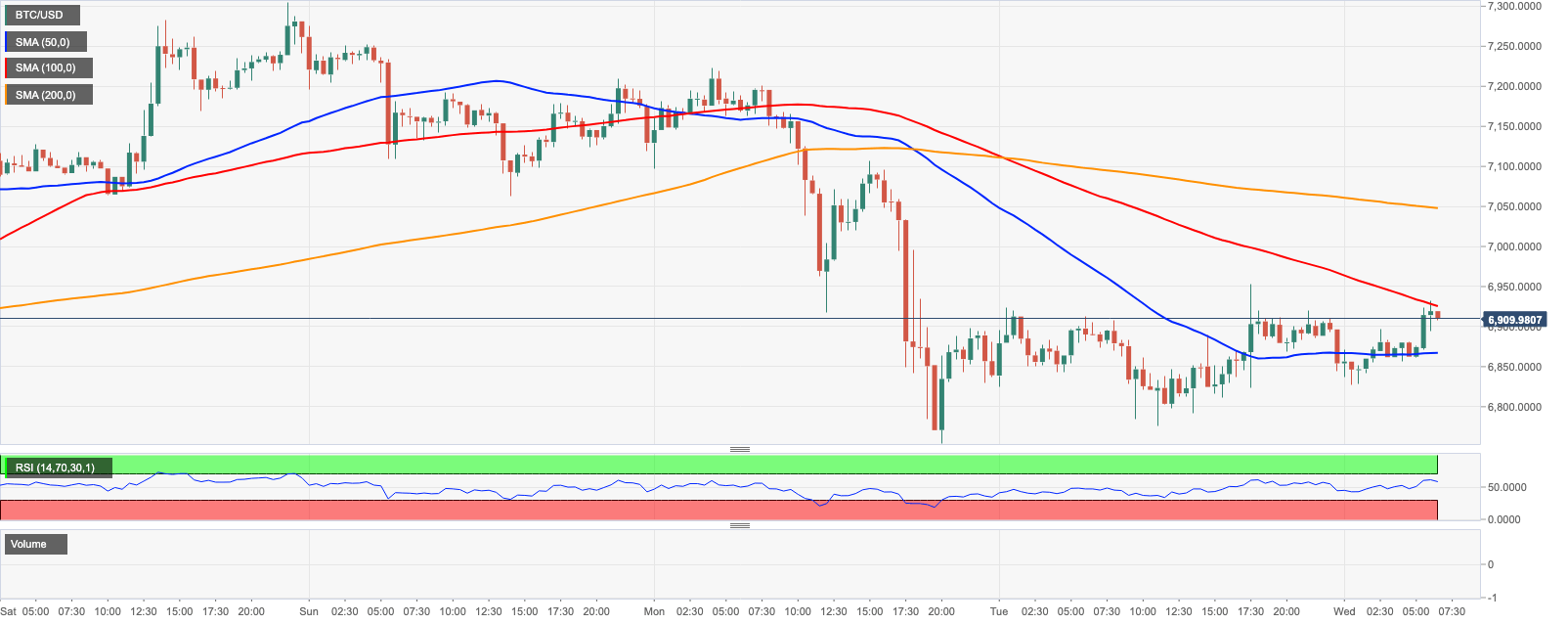
BTC/USD is hovering at $6,900. The coin recovered from the intraday low $6,826, however, the recovery momentum faded away. BTC/USD has stayed mostly unchanged both on a day-to-day basis and since the beginning of the day. Now it is trading with the short-term bullish bias amid low volatility.
At the time of writing, ETH/USD is changing hands at $173.80. The second-largest coin hit the intraday low $170.05 but managed to regain the ground. Despite the correction, the coin stayed unchanged from this time on Monday and 1.7% higher from the start of Wednesday. ETH/USD is moving within a short-term bullish trend. The volatility is low.
XRP/USD is changing hands at $0.1852 during early Asian hours, close the intraday high. The coin has gained 1.0% since the beginning of the day and stayed unchanged in the recent 24 hours. From the short-term perspective, XRP/USD is trading within a bullish trend amid shrinking volatility.
Among the 100 most important cryptocurrencies, DigiByte (DGB) $0.0078 (+6.8%) , Status (SNT) $0.0172 (+4.9%), Horizen (ZEN) $5.86 (+4.0%). The day’s losers are Quant (QNT) $5.19 (-6.0%), Terra (LUNA) $0.1976 (-4.5%) and MaidSafeCoin (MAID) $0.1104 (-4%)
Chart of the day:
BTC/USD, 30-min chart
Industry
Switzerland’s Federal Office of Public Health (FOPH), has been developing decentralized coronavirus contact tracing app together with a group of European privacy experts. The app is supposed to be ready by May 11. It will be based on the Decentralized Privacy-Preserving Proximity Tracing (DP-PPT, or DP3T) protocol, developed by scientists from the Swiss Federal Institute of Technology, ETH Zurich and Belgian KU Leuven and other European research institutions.
The app will allow tracing coronavirus contact via Bluetooth technology that will help to protect users’ privacy and prevent governments from misusing the data after the pandemic dies down. Carmela Troncoso, a professor at the Swiss Federal Institute of Technology commented:
Our protocol is demonstrative of the fact that privacy-preserving approaches to proximity tracing are possible, and that countries or organizations do not need to accept methods that support risk and misuse. Where the law requires strict necessity and proportionality, and societal support is behind proximity tracing, this decentralized design provides an abuse-resistant way to carry it out.
According to the “State of the Network” report, published by the research firm CoinMetrics the trading platform for cryptocurrency derivatives BitMEX struggles to regain the lead in the market after the “Black Thursday”, when BTC lost nearly half of its value. Many industry experts, including FTX CEO Sam Bankman-Fried, believe that BitMEX played a major role in the market collapse, as massive positions liquidation intensified the sell-off. Moreover, the platform went offline due to a DDoS attack when BTC staged a massive comeback. The amount of BTC held by the platform decreased substantially after the dramatic event.
Notably, since the crash, there has been a reshuffling of the top futures marketplaces for crypto assets with BitMEX losing some of its market share to Binance. This may have an on-going impact across crypto markets, especially considering BitMEX’s outsized influence on price discovery. Only time will tell if BitMEX is able to recover the lost market share, or if the marketplace is undergoing a true changing of the guard.
Several cryptocurrency mining farms in North America use the electricity generated by flared gas. However, if the oil market collapses, they may lose the access to those power sources.
The mining facilities in question are Upstream Data in Canada, Crusoe Energy in Colorado and DJ Bitwreck in Texas. They may not enjoy the oil slump as their operations can quickly become unprofitable once they lose access to cheap energy, especially ahead of Bitcoin’s halving. Only large players will withstand months without profits if the bitcoin price remains low.
Regulation
The Oxford College Legislation School published a research paper that argued that cryptocurrency payments should be restricted in times of disaster in order to prevent the systemic threat to the traditional monetary system.
The researchers Hadar Jabotinsky and Roee Sarel say that the behavior of cryptocurrency markets leads to systemic risks for the normal monetary system. As the cryptocurrency industry gets integrated into the traditional monetary institutions, there is a risk that a collapse of one institution will trigger a cascading impact.
In a nutshell, if, as our findings recommend, traders initially view the crypto market is an alternative choice to the normal monetary markets in occasions of disaster, then regulating it will probably assist in stopping systemic danger to the “actual” monetary markets, they wrote.
 Share
Share