Forex Crunch Sponsor

Category: EUR/USD Daily

EUR/USD May 17 – Little Change After Weak US Data


EUR/USD continues to trade quietly, with the pair trading in the high-1.28 range in Friday’s European session. On Thursday, US key releases, notably Unemployment Claims, were disappointing, but the euro failed to take advantage and didn’t make up ground against the dollar. There are no Eurozone releases on Friday. In the US, there are just three releases, highlighted by UoM Consumer Sentiment. The markets are expecting substantial improvement from the key indicator, which came in well below expectations in April.

Here is a quick update on the technical situation, indicators, and market sentiment that moves euro/dollar.

EUR/USD Technical

  • Asian session: Euro/dollar lost ground, touching a low of 1.2851 and consolidating at 1.2858. The pair has edged higher in the European session.
  • Current range: 1.28 – 1.2880.

Further levels in both directions:  

  • Below: 1.2805, 1.2750, 1.27, 1.2624 and 1.2587.
  • Above: 1.2880, 1.2960, 1.30, 1.3030, 1.31, 1.3160 and 1.32.
  • 1.2805 is the border of the long term 1.2805 – 1.3170 and is critical support.
  • 1.2880 continues to provide resistance, but it is a weak line. 1.2960 is more significant.

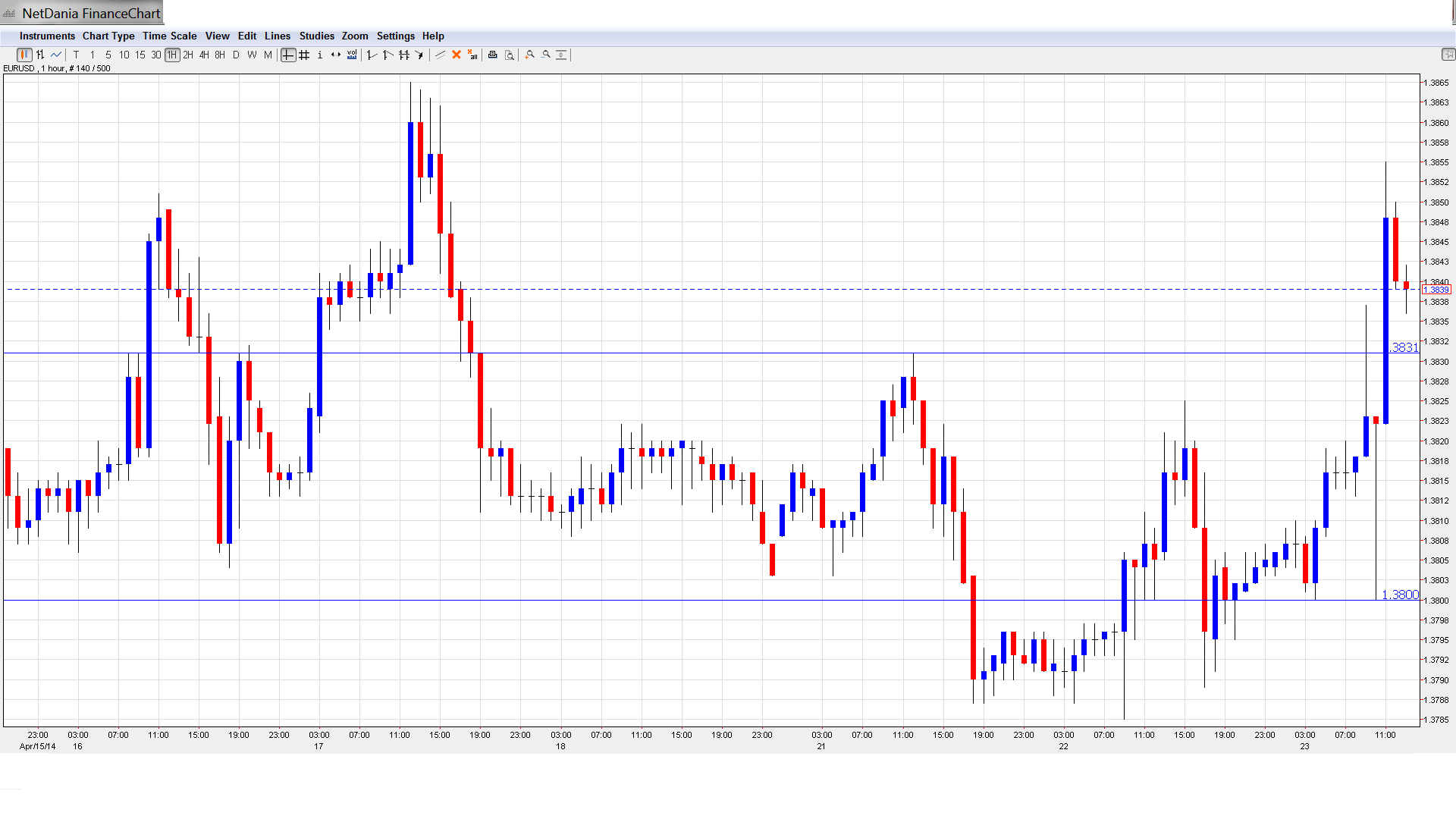
Euro steady as US churns out weak key numbers – click on the graph to enlarge.

EUR/USD Fundamentals

  • 13:55 US Preliminary UoM Consumer Sentiment. Exp. 77.9 points.
  • 13:55 US Preliminary UoM Inflation Expectations.
  • 14:00 US CB Leading Index. Exp. 0.3%.

For more events and lines, see the Euro to dollar forecast

EUR/USD Sentiment

  • US data misses the mark: The markets were saturated with a host of key US releases on Thursday, but for the most part, the news was not encouraging. Core CPI posted a weak gain of 0.1%, shy of the estimate of a 0.2% gain. Unemployment Claims had looked impressive in recent readings, but this time the key indicator couldn’t keep pace this week as new claims jumped to 360 thousand, blowing past the estimate of 332 thousand. The Philly Fed Manufacturing Index dropped into negative territory, posting a reading of -5.2 points. The markets had expected a gain of 2.5 points. Housing Starts fell sharply, from 1.04 million to 0.85 million. This was well below the estimate of 0.98 million. There was some good news from Building Permits, which climbed up to 1.02 million. This beat the estimate of 0.94 million. The weak numbers will again bring into question the extent of the US recovery, which has not been able to demonstrate sustained growth and continuous positive releases.
  • Euro-zone recession continues: Eurozone indicators did not have a good week, as economic releases pointed to contraction in the Eurozone for the third consecutive quarter. Output fell by 0.2%. At the time of the publication, this wasn’t totally unexpected, as Germany provided a big disappointment earlier: the economy grew by only 0.1% in Q1, short of 0.3% expected. Q4 was revised to a contraction of 0.7%. GDP numbers out of France and Italy continue to post declines, and both missed their estimates. The euro lost ground as a result, and dipped below the 1.29 level for the first time since early April.
  • ECB considers negative deposit rates: The mention of negative deposit rates by ECB policymakers has not been accidental. ECB head Mario Draghi mentioned the idea when the ECB lowered interest rates a few weeks ago. Earlier in the week, ECB member Ignazio Visco reiterated that the ECB is considering the idea. The ECB would be the first major central bank to adopt negative deposit rates. Proponents of the idea argue that it would increase lending to businesses and help boost economic activity in the sluggish Eurozone, but it could also scare money away, as deposit holders look for more attractive locations to park their funds. The mere mention of the idea weighs on the euro. If the ECB takes steps to implement negative rates, we can expect the euro to react negatively.
  •  Will Fed scale back QE?: This is the vexing question facing the Federal Reserve. Has the US recovery gained a stronger footing? The Fed mentioned that fiscal policy is restraining the recovery, but at least tax revenue is up, and this defers the political issues regarding the debt ceiling. On Thursday, John Williams, president of the Federal Reserve Bank of San Francisco, stated that the Fed could begin reducing QE this summer and end bond buying late in 2013. Was this statement a trial balloon from Bernanke, intended to see how the markets would react? As the QE program is dollar negative, we can expect any statements from the Fed about scaling back QE to impact on EUR/USD.
EUR/USD May 16 – Steady as Markets Await Key US Releases

EUR/USD May 16 – Steady as Markets Await Key US Releases

EUR/USD continues to trade under the 1.29 level, following weak releases on Tuesday out of Europe in the US. In the Eurozone, French German and Italian GDP all missed their estimates. In the US, there was disappointing inflation and manufacturing numbers. Taking a look at Wednesday’s releases, Eurozone CPI and Core CPI matched their estimates, while Italian and Eurozone trade balances beat the forecast. The markets will have plenty of

EUR/USD May 15 – Suffers from weak GDP numbers, fails to recover on weak US data

EUR/USD May 15 – Suffers from weak GDP numbers, fails to recover on weak US data

EUR/USD was hit by a constant flow of disappointing GDP numbers from the old continent: France officially entered a recession, Germany barely escaped one and Italy’s economy contracted again. These numbers sent the pair to new lows. Also data from the US fell short of expectations, but euro/dollar only saw a limited bounce, far from a

EUR/USD –  Steady as German Data Disappoints

EUR/USD – Steady as German Data Disappoints

EUR/USD remains steady, as the pair continues to trade close to the 1.30 level. German numbers failed to impress on Tuesday. German inflation releases posted declines, but did manage to meet market expectations. German ZEW Economic Sentiment, the highlight of the day, was a major disappointment, as it came in well below the estimate. Eurozone numbers fared better, as Industrial Protection beat

EUR/USD May 13 – Drops Below 1.30 as Dollar Rallies

EUR/USD May 13 – Drops Below 1.30 as Dollar Rallies

EUR/USD dropped close to one-month lows, as the pair fell below the 1.30 level on Friday. The dollar took advantage of solid US employment numbers, which has raised speculation that the US Federal Reserve could wind up its QE program earlier than expected. US releases wrapped up a very quiet week on a positive note, as the federal budget surplus was higher than expected.

EUR/USD May 10 – Slides After Strong US Employment Numbers

EUR/USD May 10 – Slides After Strong US Employment Numbers

 EUR/USD volatility continues, as the pair changed direction on Thursday, posting sharp losses. The euro shed more than one cent, and was trading in the low-1.30 range in Friday’s European session. As for economic releases, this week has been unusually quiet, with only one key event –  US Unemployment Claims, which was released on Thursday. The key weekly indicator continues to look

EUR/USD May 9 – Higher After Solid German Manufacturing Numbers

EUR/USD May 9 – Higher After Solid German Manufacturing Numbers

There was only one Eurozone release on Wednesday, but EUR/USD took full advantage of a sharp German Industrial Production reading, which hit a ten-month high. The euro responded by gaining close to a cent, and was trading in the mid-1.31 in Thursday’s European session. The markets are closed in Germany and France for a holiday, and the lone

EUR/USD May 8 – Little Movement as Markets Eye German Data

EUR/USD May 8 – Little Movement as Markets Eye German Data

So far this week, we haven’t seen any major releases from the Eurozone or the US, and predictably, EUR/USD has responded with little movement. The pair continues to test the 1.31 line in Wednesday’s European session. With what looks to be another quiet day, today’s releases could have added significance. The lone Eurozone release is German Industrial Production.

EUR/USD May 7 – Under  Pressure as Draghi Mulls Further Cuts

EUR/USD May 7 – Under Pressure as Draghi Mulls Further Cuts

After some sharp movement last week, EUR/USD has quieted down, and was trading in the high-1.30 range. With the ECB’s interest rate cut behind us, it remains to be seen if the Eurozone economy will get a lift and produce better numbers. Meanwhile, ECB head Mario Draghi said that the ECB could make further cuts if needed. In economic news, France

EUR/USD May 6 – Settles Down After ECB Excitement

EUR/USD May 6 – Settles Down After ECB Excitement

After some sharp movement last week, EUR/USD has settled down, and was trading in the low-1.31 range. With the ECB’s interest rate cut behind us, the markets have turned their attention to Monday’s Eurozone releases. In Spain, Unemployment Change looked very sharp, while Services PMI missed the estimate. Meanwhile, Italian Services PMI and Final Services PMI both beat expectations. ECB Mario Draghi will